
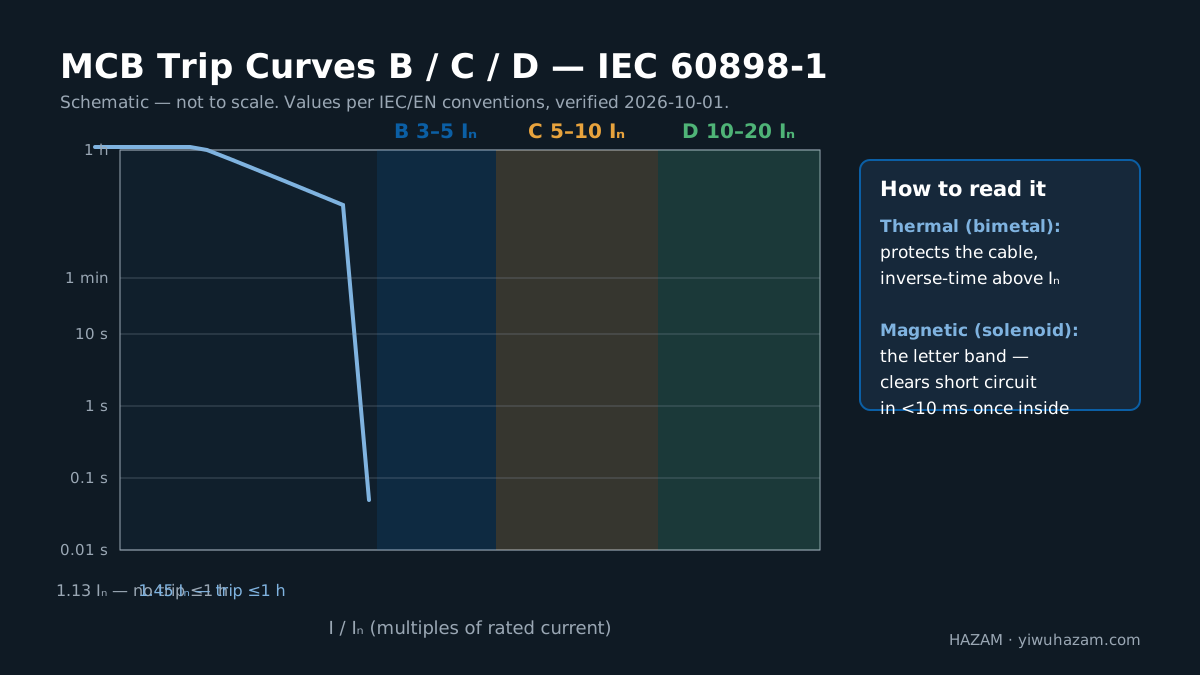
Short answer: the letter is the instantaneous (magnetic) trip band, expressed as multiples of rated current. In IEC/EN 60898-1 terms, Type B trips magnetically between roughly 3 and 5 × In, Type C between 5 and 10 × In, Type D between 10 and 20 × In. The ampere rating protects the cable; the letter protects you against the load’s switch-on surge. Choose the letter from the load, never from the nuisance trip.
Order the wrong letter and one of two things happens: the breaker trips every time the pump starts, or it does not trip when a motor stalls. The first complaint arrives in week one. The second arrives as a fire report.
Two separate trip mechanisms in one 18 mm module
| Mechanism | Protects against | Behaviour | Defined by |
|---|---|---|---|
| Bimetal strip (thermal) | Sustained overload | Inverse time: the further above rated current, the faster it trips | The ampere rating (In), not the letter |
| Solenoid (magnetic) | Short circuit | Essentially instantaneous, below 10 ms once the band is exceeded | The letter (B / C / D) |
The conventional thermal points published in manufacturer curves for IEC/EN 60898-1 devices are the useful pair to quote to a client: at 1.13 × In the device must not trip within one hour; at 1.45 × In it must trip within one hour (for ratings up to 63 A; above 63 A the conventional time is two hours). That band is why “just go one size up” is not engineering — it moves the whole thermal curve away from the cable’s own heating curve.
The three letters, in the field
| Curve | Magnetic band | Typical load | What goes wrong if you pick it |
|---|---|---|---|
| B | 3–5 × In | Domestic lighting, socket outlets, resistive heating, boards with long final circuits | Trips on transformer or LED-bank inrush; common when a residential curve is shipped into a small-industrial job |
| C | 5–10 × In | General commercial and light industrial, small motors, discharge lighting, the default in most of our markets | Still trips on large contactor-driven loads, UPS input stages and welders — the surges reach 10–15 × In |
| D | 10–20 × In | Control transformers, motor starting duty, pumping sets, anything with heavy measured inrush | Loss of earth-fault sensitivity on long circuits: a high-impedance fault may not reach the magnetic band at all, so the breaker “refuses” to clear. This is where D is over-specified as a fix |
Two cautions we put in writing on every curve change:
- Publish the datasheet, not the habit. Some manufacturer curve sets show the D band as 10–14 × In rather than 10–20 × In, because the instantaneous accuracy class differs between IEC/EN 60898-1 (household devices) and IEC/EN 60947-2 (industrial devices, where the band is often stated as a fixed multiple with a tolerance, e.g. 12 ± 20 %). If your project submittal quotes a band, quote it from the datasheet of that exact ordering code.
- Breaking capacity is a separate number. Curve C 32 A at 6 kA and curve C 32 A at 10 kA are the same tripping behaviour and a different device. See 6 kA vs 10 kA MCB.
What we ship by market
- Russia and CIS: C is the stock expectation; 2P and 2P+N combinations are common, and the neutral is often carried through a device that does not disconnect it. We quote pole configuration explicitly rather than assuming.
- Gulf: C for distribution boards, B for final lighting and socket circuits in residential towers, D on request for pumping and lift circuits.
- West and East Africa: C dominates residential/small-commercial boards. Where the supply is a long rural feeder, the available fault current at the far end can be low, and a B curve clears earth faults more reliably than an oversized C — worth saying to the client who wants “the bigger one”.
- Egypt / MENA: C for boards, D for agricultural and water-pumping installations.
- South American cone: C for installations, Spanish-language marking on request.
[ADD: one real order where the customer asked for D to stop nuisance tripping and the actual cause was X — this paragraph is the most valuable thing in the article and only you can write it]
How to specify it without a fight
- Name the load, not the room: “1.5 kW three-phase pump, DOL start” beats “motor circuit”.
- Give measured or catalogue inrush if you have it. If you do not have it, say so and we will propose a curve plus a verification method rather than guess.
- State cable size and run length. The breaker protects the cable; if the cable is undersized for the intended In, no letter fixes that.
- State the standard the specifier must satisfy (IEC/EN 60898-1 for modular household-type devices, IEC/EN 60947-2 for industrial MCCB/ACB duty) and the destination certificate requirement.
- Confirm availability at the board: at the transformer end of a short, fat cable, fault current is high and both the curve and the kA rating matter.
Our range, as published
| Series | Standard | Curves | In | Icn | Poles |
|---|---|---|---|---|---|
| CHINT NB1-63 | IEC/EN 60898-1 | B / C / D | 1–63 A | 6 kA | 1P, 1P+N, 2P, 3P, 3P+N, 4P |
| CHINT NB1-63H | IEC/EN 60898-1 | B / C / D | 1–63 A | 10 kA | 1P–4P |
| CHINT NXB-63 | IEC/EN 60898-1 | B / C / D | 1–63 A | 6 kA (H version 10 kA) | 1P–4P incl. 1P+N / 3P+N |
Full data and the certificate list for each: CHINT NB1-63 and MCB catalogue.
FAQ
Q: Can I replace a B curve with a C curve of the same amperage?
A: Usually yes for the cable, and it is the standard fix for lighting-bank inrush — provided the earth-fault loop impedance still gives reliable disconnection. Check the fault current at the far end of the circuit before you do it, especially on long runs.
Q: My breaker trips when the air conditioner starts. Should I go to D?
A: First confirm it is magnetic tripping and not thermal from a genuine overload or a failing capacitor. A single hard start on a correctly sized C device is usually normal; repeated trips on a locked rotor are the protection doing its job. If inrush is confirmed high, D is a legitimate answer — with the sensitivity caveat above.
Q: Is a D curve breaker stronger?
A: No. It is less sensitive to short-duration surge current. Rated current, breaking capacity and tripping class are independent specifications, and “stronger” is not one of them.
Q: Do you supply all three curves in one container?
A: [ADD: your real stocking pattern per curve/amperage combination, and the usual mixed-carton break-down by amperage]
Q: What about Z or K curves?
A: Those belong to the IEC/EN 60947-2 industrial world (e.g. 4 / 8 / 12 × In with tolerances) rather than the household B/C/D set, and they are rare outside control and semiconductor circuits. We quote them only against a specific ordering code and datasheet.
Send us the load, not the guess
Send: model or photo · quantity · destination country · grid (V / Hz / 1φ or 3φ) · load type and starting method · required certificate. You get unit price, packing data and the certificate file for the exact ordering code, within 24 hours. Request a quotation.
Related: 6 kA vs 10 kA MCB · RCCB Type AC vs Type A · contactor coil voltage and frequency · cross-reference to European ranges
CHINT, DELIXI and TENGEN are trademarks of their respective owners. HAZAM is a first-tier authorised distributor of CHINT products; the authorisation certificate is available on request from our sales manager. Ratings quoted above are from manufacturer datasheets current on 1 October 2026; the certificate for your exact ordering code governs.