
Short answer: an AC contactor coil is an inductor. Its impedance comes mostly from inductive reactance, which is proportional to frequency. Put a 50 Hz coil on a 60 Hz supply and impedance rises, current falls, the coil cannot pull the armature in fully — you get chatter, hum and a contactor that never quite closes. Put a 60 Hz coil on a 50 Hz supply and impedance falls, current rises, the coil overheats and eventually burns. Neither fault shows up on the day the panel is energised; both show up in the second month of summer.
This is the single most common specification error we see on quotations destined for 60 Hz grids, and it is entirely preventable at the ordering-code stage.
Read the coil marking before you read the price
Two numbers on a contactor nameplate are independent decisions: the main circuit rating (AC-3 amperage at 400 V, utilisation category) and the control circuit voltage (the coil). Buyers quote the first and forget the second. The coil is what kills you.
| Range | Standard | Coil options (as published) | Notes |
|---|---|---|---|
| CHINT CJX2 | IEC/EN 60947-4-1 | AC 24 / 36 / 110 / 127 / 220 / 380 / 400 V | Pick-up 85–110 % of Us; drop-out 20–75 % of Us |
| CHINT NC1 | IEC/EN 60947-4-1 | Same band as CJX2, up to 95 A AC-3 | Economy international version |
| CHINT NXC | IEC/EN 60947-1/-4-1 | AC 24–660 V multi-tap; DC 24 / 48 / 110 / 220 V; AC/DC mixed coil 265–630 V | 6–630 A AC-3; the mixed-coil version removes most frequency arguments |
| CHINT NC2 | IEC/EN 60947-4-1 | Control voltages per coil table — confirm per code | 115–800 A AC-3, AC-1 up to 1500 A |
Verified against the manufacturer’s published product pages and catalogue data, 1 October 2026. Where a coil voltage is not in the manufacturer’s table, we treat it as a non-standard build and say so on the proforma.
Why frequency changes everything on an inductive coil
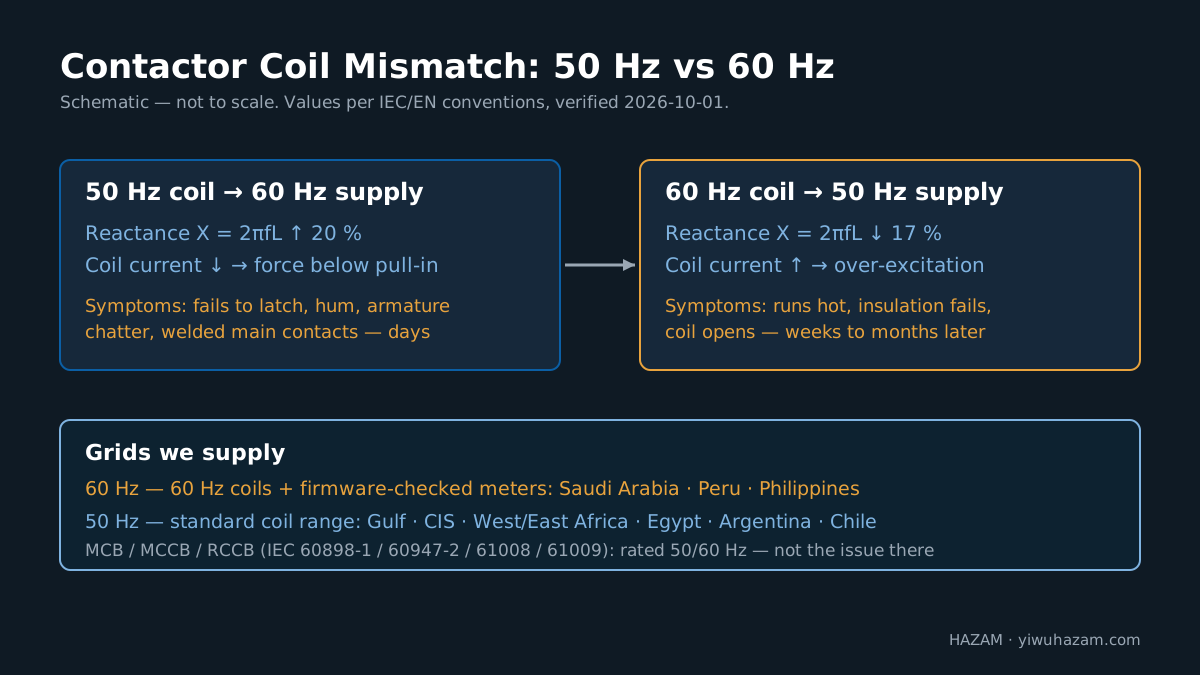
Coil impedance is dominated by XL = 2πfL. Inductance L is fixed by the winding and the core; frequency f is fixed by your customer’s grid. Change one, and only one thing gives: current.
| Mismatch | What happens electrically | What the customer sees | Failure timing |
|---|---|---|---|
| 50 Hz coil on 60 Hz supply | Reactance up ~20 %, coil current down, magnetic force below pull-in margin | Closed contact fails to latch, buzzing, armature chatter, main contacts bounce and weld | Immediate or within days; chattering contacts fail first |
| 60 Hz coil on 50 Hz supply | Reactance down, coil current up above design, continuous over-excitation | Coil runs hot, insulation degrades, varnish discolouration, then open circuit | Weeks to months — the worst kind, because the shipment clears inspection |
| Correct frequency, wrong voltage class | Under-voltage: fails to pull in. Over-voltage: saturates and overheats. | Intermittent drop-outs under load, control transformer sized wrong | Variable; blamed on “bad quality” in both cases |
Thermal overload relays are a separate story. The bimetal element is essentially frequency-independent, but the relay must be paired with a contactor of the same coil specification — otherwise you inherit the contactor’s problem and lose the diagnostic clue.
Which of our markets are 60 Hz
We supply 220–240 V / 50 Hz gear as standard. These are the places where “standard” is not enough:
- Saudi Arabia — 60 Hz. The national grid code sets nominal 60 Hz. MCBs, MCCBs and RCCBs under IEC 60898-1 / 60947-2 / 61008 / 61009 are generally rated 50/60 Hz and are not the problem. Contactors, metering devices and anything with an electronic supply are. Saudi also runs a mixed 127 V / 230 V legacy with an approved but incomplete migration to 230/400 V, so single-phase control circuits need confirming too. See our Saudi Arabia page.
- Peru — 220 V but 60 Hz. Voltage looks familiar, frequency does not. Coil and firmware questions apply.
- Philippines — 220 V / 60 Hz with widespread 110/115 V socket circuits. We do not treat this as a standard-supply market; tell us the actual site condition.
- Gulf (UAE, Qatar, Kuwait, Oman, Bahrain), Russia and the CIS, West and East Africa, Egypt, Argentina, Chile, Paraguay, Uruguay, Bolivia — 50 Hz. Standard coil range fits; voltage class still to be confirmed.
The four questions that decide the quotation
We ask these before giving a contactor price. If another supplier does not ask them, compare like with like before you place an order anywhere.
- Destination country — which then implies grid frequency.
- Voltage (127 / 220 / 230 / 400 / 415) and single-phase or three-phase.
- Coil voltage of the control circuit, and its frequency — taken from the existing panel label, not from habit.
- Utilisation category and load type: AC-3 motor with a duty cycle, or AC-1 resistive. Motor inrush determines the frame; the coil determines whether it closes at all.
Ordering codes matter literally. On the CJX2 family the last two digits describe auxiliary contacts — 10 = 1NO, 01 = 1NC, 11 = 1NO + 1NC — so CJX2-3210 is a 32 A AC-3 device with one normally-open auxiliary contact. The coil voltage is a separate suffix. A quotation that says only “CJX2-3210 220V” is ambiguous: 220 V of what, at what frequency? We write it as coil voltage + frequency + terminal designation on the proforma, and we photograph the coil nameplate of the actual lot before loading.
When we quote a DC coil instead
Where a plant has mixed or unreliable control voltage, or where the panel already runs DC control (24 V DC PLC supplies are common on African and Gulf industrial projects), a DC coil on the NXC removes the frequency dependency altogether — DC coils are rated by voltage only. It also removes the hum. The trade-off is a bulkier rectifier/surge assembly in the coil and a hard requirement that the control supply matches. Send us the control schematic if you are retrofitting; we would rather change the coil specification now than the whole contactor later.
FAQ
Q: Are CHINT MCBs usable in a 60 Hz country?
A: Yes. NB1-63, NB1-63H and NXB-63 are rated for AC 50/60 Hz under IEC/EN 60898-1. The breaker is not the frequency-sensitive part; the contactor coil and any electronic metering are.
Q: Can I fit a 60 Hz coil to a 50 Hz panel if it is the only stock available?
A: Not as a permanent solution. Current rises well above design, the coil overheats and insulation life collapses. If you are stuck, derate nothing and improvise nothing — re-order the correct coil or the correct cover assembly.
Q: My contactor buzzes after commissioning. Is it counterfeit?
A: Most buzz we get asked about is frequency or undervoltage, not fakes. Check supply frequency against the coil marking, then measure control voltage at the coil terminals under load. Only after both are correct does authenticity come into the diagnosis — here is our verification checklist.
Q: What is the difference between AC-3 and AC-4?
A: AC-3 is normal motor starting and running with the motor switched on while running only rarely; AC-4 is plugging, inching or reversing — high make-and-break duty on a stalled motor. An AC-4 duty on an AC-3-rated frame is a lifetime problem, not a capacity problem, and it will be blamed on the brand.
Q: Do you stock 60 Hz coils in Yiwu?
A: [ADD: which coil voltages you genuinely keep on the shelf, typical lead time for a non-standard coil, and one photo of a coil nameplate]
Q: Can you mark the coil voltage on the outside of the carton?
A: Yes, and we do it on request, because mixed-coil containers are how this mistake survives to site. [ADD: whether you charge anything for this and the minimum quantity]
Get a specification, not a guess
Send: model or photo · quantity · destination country · grid (V / Hz / 1φ or 3φ) · coil voltage and frequency · required certificate. You get unit price, coil code, packing data (pcs / carton / GW / CBM) and the certificate file for the exact ordering code — within 24 hours. Request a quotation or use WhatsApp.
Related: AC contactors & overload relays · Saudi Arabia: 60 Hz and SASO/SABER · UAE & Gulf: 230/400 V 50 Hz · FAQ: grids and certificates
CHINT, DELIXI and TENGEN are trademarks of their respective owners. HAZAM is a first-tier authorised distributor of CHINT products; the authorisation certificate is available on request from our sales manager. All brand references are for the purpose of identifying the goods we supply. Published ratings refer to manufacturer datasheets current on the date above; the certificate file for your exact ordering code governs.