
Short answer: the kA figure on an MCB is its rated short-circuit breaking capacity — the prospective fault current the device is proven to interrupt and survive. It has nothing to do with how fast it trips or how much overload it tolerates. In practice: 6 kA (Icn under IEC/EN 60898-1) covers the majority of domestic boards downstream of a properly sized transformer; 10 kA belongs at the supply end of a distribution board, in small-industrial feeders, and on any installation with short, low-impedance cable runs where available fault current is high.
The mistake is not “too small”. The mistake is specifying 10 kA everywhere because it feels safer, then wondering why the bill jumped — or worse, mixing a 6 kA device upstream of a 10 kA device and calling the combination “coordinated”.
Three numbers on the nameplate, and only one is the kA rating
| Symbol | Meaning | Standard | Why buyers confuse it |
|---|---|---|---|
| In | Rated current, in amperes — the thermal overload reference | IEC/EN 60898-1 | It is the biggest number on most nameplates, so people read it first |
| Icn / Icu | Rated breaking capacity — the prospective AC current the device can interrupt | 60898-1 uses Icn; 60947-2 uses Icu | This is the 4.5 / 6 / 10 / 15 / 25 kA figure |
| Ics | Service breaking capacity — the level at which the device still works afterwards | IEC/EN 60947-2 (MCCB/ACB) | Household MCB datasheets often do not publish it at all, so a “10 kA” claim can mean two different things |
One more that matters when the client asks about selectivity: Icw is the rated short-time withstand current (for MCCBs and ACBs, usually expressed in kA for a stated duration such as 1 s). Standard modular MCBs under 60898-1 are not sold on an Icw rating. If a submittal asks for a 6 kA/1 s withstand on an MCB, the correct technical answer is “that is not a characteristic of this device class — here is the MCCB or ACB that has it”.
Where 6 kA is genuinely enough
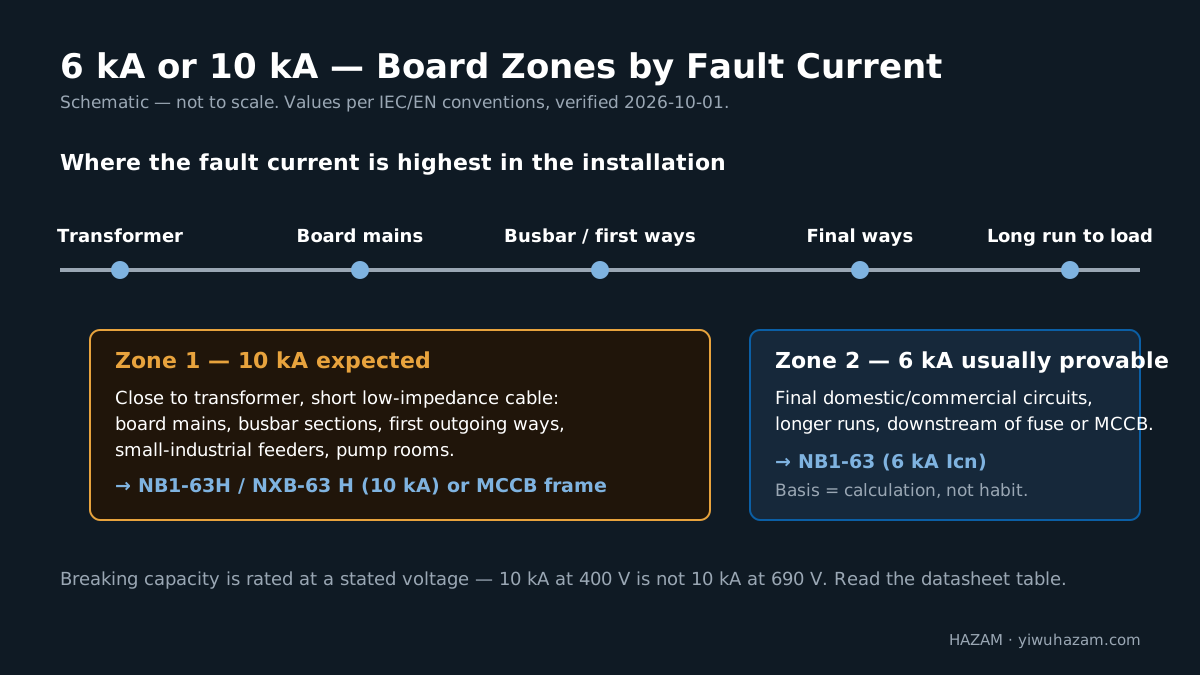
Domestic and small-commercial final circuits supplied through a normal low-voltage service, several tens of metres of network cable upstream of the board. At the origin of a typical 230/400 V installation the prospective three-phase fault current might be a few kA to something above 10 kA depending on transformer size, cable length and cross-section — the range is enormous, and it is the reason this question cannot be answered from habit.
- Final distribution boards in residential towers, villas, shops: 6 kA on outgoing ways is the market default across the Gulf, Africa, CIS and South America.
- Boards where the incoming protection is a fused switch or an MCCB that limits the energy anyway.
- Where the designer has calculated the fault level and it lands under 6 kA. That is the honest basis, and we will happily quote to it if the calculation is attached to the enquiry.
Where you need 10 kA
- Board mains, busbar sections and the first ways out of a large supply. Fault current is highest nearest the transformer.
- Small industrial feeders, pump rooms, workshops with short cable runs and low source impedance.
- Any project where the client’s own standard says 10 kA. Utility and EPC specifications in our markets frequently mandate 10 kA minimum at the origin irrespective of calculation, because they are tired of being blamed.
- When the alternative is a 6 kA device plus a back-up fuse. Sometimes the cheaper, more correct answer is a properly coordinated fuse ahead of it.
In our range the 10 kA modular options are CHINT NB1-63H (10 kA, same footprint and accessories as NB1-63) and NXB-63 in its H version. Not a different brand, not a “heavy duty” sticker — a different ordering code with a different test certificate, which is exactly what we send you before payment.
What a “10 kA claim” has to be backed by
- The datasheet for the exact ordering code, showing Icn/Icu at the operating voltage you intend to use it at. Breaking capacity is voltage-dependent; a rating quoted at 230 V does not automatically hold at 415 V.
- The certificate (CB report / national certification) covering that code, not the family, and not a generic CE image.
- Where a project requires it, the I ²t and peak let-through curves — the numbers an engineer actually needs for coordination. Manufacturer datasheets publish them; third-party resellers usually do not.
We publish the certificate file for the code we quote. If a competing quotation is cheaper on a “10 kA MCB”, ask for these two documents and see what arrives. Our verification checklist covers the counterfeit route; this is the specification route, and it is where most of the money is actually lost.
Frequency note
Modular MCBs to IEC/EN 60898-1 are rated for AC 50/60 Hz, so a 60 Hz grid (Saudi Arabia, Peru, Philippines) does not by itself force a different breaking capacity. Frequency is a contactor coil and electronic metering problem — see contactor coil voltage and 50 Hz vs 60 Hz.
FAQ
Q: Is a 10 kA breaker better than a 6 kA breaker?
A: It is rated to interrupt a higher prospective fault current. Nothing else about it is “better”: same trip curve set, same thermal characteristics, same cable protection. Specifying it where 6 kA is proven sufficient costs money and buys no additional safety.
Q: What happens if fault current exceeds the breaking capacity?
A: The arc may not be extinguished inside the housing. Contact materials weld, the enclosure can rupture, and the upstream protection may clear the fault while the downstream device is destroyed. The installation remains unprotected during the event and the device cannot be trusted afterwards — this is why a breaker that has interrupted above its rating is scrapped, not reset.
Q: Can I mix 6 kA and 10 kA devices in one board?
A: Yes, and it is normal: 10 kA at the origin, 6 kA on final ways. What you must not do is rely on a 6 kA device to protect a 10 kA busbar section. Note that “coordinated” in standards terms means tested up-stream/down-stream combinations, not a size ladder.
Q: Does higher kA mean faster tripping?
A: No. Magnetic trip speed is a function of the curve and the current, not the breaking rating. Higher kA is about survivability at the end of the arc, not about how quickly the contacts part.
Q: Do you stock both ratings?
A: [ADD: what NB1-63H / NXB-63 H you actually keep on the shelf, per curve and amperage, and the usual price gap your customers see]
Quote to a number, not to a feeling
Send: model or photo · quantity · destination country · grid (V / Hz / 1φ or 3φ) · available fault current at the board if known · required certificate. You get unit price, packing data (pcs / carton / GW / CBM) and the certificate file for the exact code, within 24 hours. Request a quotation.
Related: MCB trip curve B, C or D · CHINT NB1-63 specifications · MCB catalogue · cross-reference to Schneider, ABB and Siemens ranges
CHINT, DELIXI and TENGEN are trademarks of their respective owners. HAZAM is a first-tier authorised distributor of CHINT products; the authorisation certificate is available on request from our sales manager. Values above refer to manufacturer datasheets current on 1 October 2026; the certificate for your exact ordering code governs.