
Short answer: the letter on a residual current device describes which waveforms of earth-leakage current it is proven to detect. Type AC responds only to sinusoidal AC residual current. Type A adds pulsating DC residual current (with a smooth DC component up to 6 mA). Type F adds mixed-frequency components from single-phase control equipment (smooth DC up to 10 mA). Type B adds smooth DC and high-frequency residual currents up to 1 kHz. The failure mode is always the same and never obvious: the device simply does not trip when a real fault occurs, because the fault current contains a component it was never built to see.
Nothing about this is theoretical in our product line, because Type AC RCCBs are cheaper than Type A in the same frame, and a buyer comparing two quotations will see the difference without seeing the reason.
The type table, as the standards define it
| Type | Trips on | Smooth DC component tolerated | Typical loads behind it |
|---|---|---|---|
| AC | Sinusoidal AC residual current only (50/60 Hz) | None — not tested under DC | Resistive heating, incandescent/halogen lighting, plain socket circuits with no electronics |
| A | AC + pulsating DC residual current | Up to 6 mA | Switch-mode power supplies, LED drivers, inverter air conditioners, most modern equipment |
| F | AC + pulsating DC + mixed-frequency components | Up to 10 mA | Single-phase variable-speed drives, dimmers, domestic laundry/appliance circuits with electronic control |
| B | All of the above + smooth DC + residual AC up to 1 kHz | Up to 0.4 × IΔn or 10 mA, whichever is greater | Three-phase drives, PV inverters, EV charging, UPS, medical and industrial power electronics |
Definitions per IEC/EN 61008 (RCCB), 61009 (RCBO) and the equivalent national adoptions; the DC-magnitude notes are the standard’s own test conditions. Verified against published standards summaries and manufacturer technical literature, 1 October 2026.
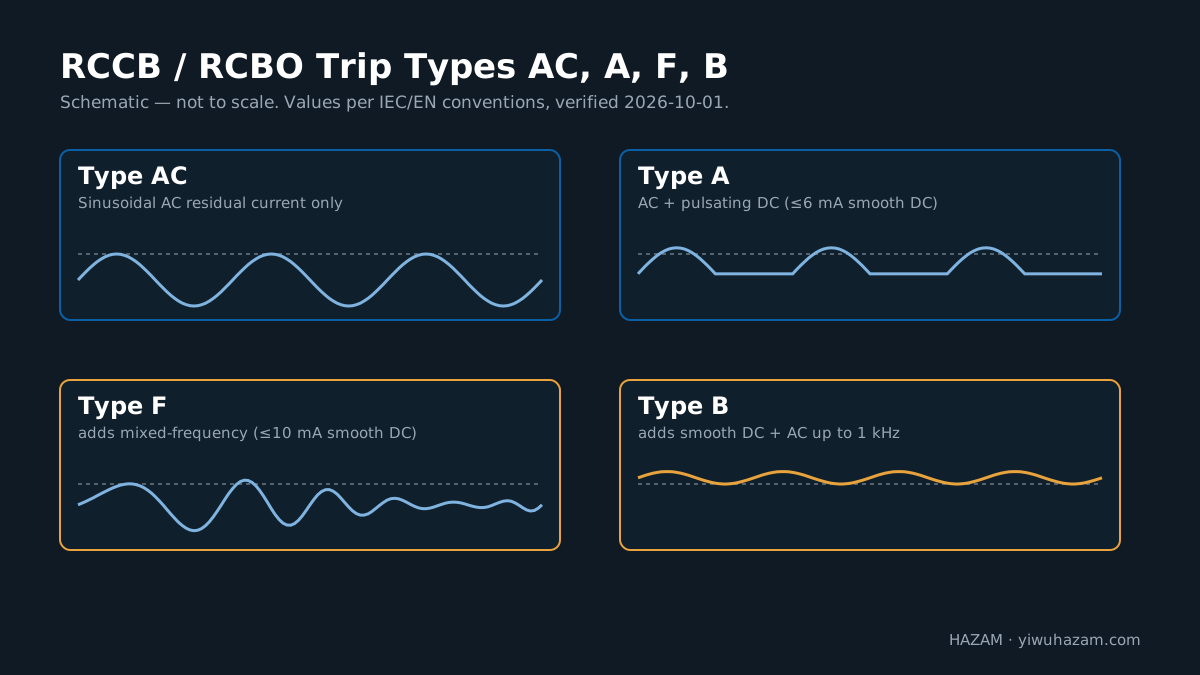
Why the wrong type fails silently
A saturating core is the mechanism. An electromechanical RCCB senses residual current with a toroidal transformer. Pulsating DC in the fault current biases the core toward saturation; once saturated, the transformer stops transferring the AC component to the trip relay, and the device stops seeing the fault at all. Type A devices are built and tested to resist that up to the stated 6 mA bias; Type AC devices are not tested for it, and “not tested” is not the same as “works”.
The practical consequence in our markets:
- An installation full of LED drivers and inverter AC units protected by Type AC devices looks perfectly compliant on the invoice and behaves unpredictably in fault conditions.
- Solar and UPS circuits generate smooth DC residual current. A Type A or even Type AC device on the AC side of certain faults will not clear it — this is the domain of Type B (or Type F plus an RDC-DD detection device, depending on the circuit).
- Nuisance tripping is the opposite error: an over-sensitive or wrong-type device on a circuit with high leakage-to-earth from many switch-mode supplies will trip for reasons nobody can diagnose, and the client will call it “bad Chinese breakers”.
What our markets require
| Market | Practical expectation for RCCB/RCBO type | Note |
|---|---|---|
| UAE & Gulf (50 Hz) | Type A is the growing default on final ways; Type AC still specified on older residential sets | Gulf specifications increasingly follow European practice because the installed equipment base does |
| Saudi Arabia (60 Hz) | Type A; confirm the device is marked for 50/60 Hz | SASO/SABER documentation must match the exact ordering code — see our Saudi page |
| Russia & CIS | Type A widely required by design institutes; A-C-T (type AC) still common in older stock, and 30 mA vs 100 mA selection follows local practice | EAC certification applies to the device; Russian-language labelling and the EAEU licence-holder requirement are covered on the CIS page |
| West & East Africa | Type AC remains the volume product on price-sensitive residential boards; Type A for commercial and hotel work | Sale of AC-type into electronic-load circuits is the most common silent defect we see in the field |
| Egypt & MENA | Type A for project tenders; Type AC in retail replacement trade | GOEIC factory registration affects which brand/factory can legally ship — see the Egypt page |
| South America (AR/CL/PY/UY/BO) | Type A, following IEC-adoption practice; Spanish marking on request | Chile requires a per-model SEC approval — see South America |
[ADD: which of these your customers actually order, and one instance where a client’s specification said Type AC and you pushed back — this is the paragraph that proves experience]
Our published RCCB / RCBO range
| Series | Device | Standard | Types | IΔn | Poles | Inc / Icn |
|---|---|---|---|---|---|---|
| CHINT NL1-63 | RCCB (no overcurrent protection) | IEC/EN 61008-1 | AC, A (also F/S and SI per catalogue) | 0.01 / 0.03 / 0.1 / 0.3 / 0.5 A | 2P, 4P (+1P+N / 3P+N per manual) | 6 kA (10 kA on 63–100 A) |
| CHINT NB1L (-40 / -63) | RCBO, electromagnetic | IEC/EN 61009-1 | AC and A | 30 / 100 / 300 mA | 1P+N, 2P, 3P+N, 4P | 6 kA |
| CHINT NXBLE-63 | RCBO, electronic | IEC/EN 61009-1 | AC / A | 30 / 100 / 300 mA | 1P+N most common | 6 kA |
| CHINT NB2LE | RCBO, 1P+N | IEC/EN 61009-1 | AC / A | 0.03 / 0.1 / 0.3 A | 1P+N | 6 kA, IΔm 3 kA |
Certificates published by the manufacturer for these series include CB, VDE, KEMA, CE and — for NB2LE — UKCA, EAC and KC. We send the certificate file for the exact ordering code you are quoting, because “the series has EAC” and “your code has EAC” are different statements and only the second one clears customs.
Electronic versus electromechanical: the question behind the question
Electronic residual devices (most compact RCBOs, including NXBLE-63 and NB2LE) need a supply to run their sensing circuit; electromechanical ones do not. That difference shows up in three places buyers care about:
- Neutral faults. An electronic device with a broken or missing neutral reference can lose its ability to trip, and that failure is invisible from outside the board. Where the neutral is unreliable — common on older rural networks and some TT earthing systems — this matters more than the price difference.
- Surge robustness. Electronic boards respond to fast transients; the surge-current-withstand figure in the datasheet is the number to compare, not the brand.
- Test-button behaviour. On an electromechanical device the test circuit proves the trip path; on some electronic designs it proves less than people assume. Monthly test-button operation is still the cheapest diagnostic anyone has invented.
FAQ
Q: Is Type A always better than Type AC?
A: For fault detection on installations containing electronics, yes — strictly more waveforms are covered. It is not “more sensitive”: both trip at the same rated residual operating current IΔn for sinusoidal AC faults. Type A costs more because it is tested against DC bias.
Q: Do I need Type B for a solar inverter circuit?
A: On the DC side and on AC circuits directly fed by inverter output, Type B is the conservative answer, and local regulation governs. Where Type B is not required or not affordable, Type F plus recognised DC-residual detection can be the correct engineering answer. Send us the inverter datasheet and the destination country and we will quote against the standard the inspector applies.
Q: My RCBO trips only at night. Type problem?
A: Usually accumulated leakage from many switch-mode supplies rather than a device-type error — the aggregate capacitive leakage of a large number of LED drivers rises with temperature and with the number of units energised. Count the loads, split the circuit, and only then consider changing type.
Q: 30 mA or 300 mA?
A: 30 mA is direct-contact protection for people on final circuits; 300 mA is fire-protection/ground-fault monitoring on feeders. They answer different questions and are not interchangeable; a 300 mA device will not protect a person from the fault a 30 mA device is meant to clear.
Q: Can you supply Type A in the same carton as Type AC to match my mixed board list?
A: Yes — mixed cartons are the normal way we ship African and MENA board lists. [ADD: your real minimum mixed-carton quantity and how you mark type on the carton]
Send us the circuit, not just the rating
Send: model or photo · quantity · destination country · grid (V / Hz / 1φ or 3φ) · load type on the protected circuit · required IΔn and type (AC/A/F/B) · required certificate. You get unit price, packing data and the certificate file for the exact ordering code, within 24 hours. Request a quotation or WhatsApp.
Related: RCCB & RCBO catalogue · MCB trip curve B, C or D · 6 kA vs 10 kA breaking capacity · how to verify genuine product
CHINT, DELIXI and TENGEN are trademarks of their respective owners. HAZAM is a first-tier authorised distributor of CHINT products; the authorisation certificate is available on request from our sales manager. Device types and ratings above refer to manufacturer datasheets current on 1 October 2026 and to the stated IEC/EN standards; national wiring regulations and the certificate for your exact ordering code govern.