
Short answer: IEC/EN 60898-1 is the standard for miniature circuit breakers intended for household and similar installation protection — modular, 6 kA-class, tripping expressed as B/C/D multiples of rated current. IEC/EN 60947-2 is the standard for circuit breakers for industrial use — MCCBs and ACBs, higher and more explicitly tested breaking capacities, Icu/Ics/Icw/Icm ratings, utilisation categories, and often adjustable trip units. The same nominal 32 A exists under both, and the two are not interchangeable claims. A project that asks for 60947-2 compliance cannot be satisfied by a 60898-1 device, however robust it looks.
Why this matters commercially: tender documents, utility approved-lists and consultant submittals name the standard, not the brand. Get the standard wrong on the quotation and the goods are correct, the price is right, and the shipment is rejected at the site gate.
Side-by-side, on the points that decide a purchase
| Attribute | IEC/EN 60898-1 (MCB) | IEC/EN 60947-2 (CCCB / MCCB / ACB) |
|---|---|---|
| Intended user | Ordinary persons; untrained operation | Responsible/instructed persons; industrial installation |
| Typical form | Modular 9 mm-pitch DIN-rail module | Moulded case or air/insulated frame, DIN bolt-on or drawout |
| Current range | To 63 A (NB1-63, NB1-63H, NXB-63: 1–63 A) | From a few amperes to 6300 A on ACBs |
| Breaking capacity notation | Icn (also Icn class limits set by the standard’s preferred values) | Icu, Ics (% of Icu), Icw (kA for a stated time), Icm (making) |
| Instantaneous trip declaration | Conventionally B / C / D as ranges of In | Fixed multiples with tolerance, e.g. 4 ± 20 %, 8 ± 20 %, 12 ± 20 % , or adjustable electronic units |
| Reference tripping temperature | Commonly 30 °C in published curves for household devices | Commonly 50 °C for 60947-2 devices — check the datasheet of the specific device |
| Category of use | Not applicable (A/C-type installation protection) | Category A (no rated short-time withstand current specified) or Category B (with Icw) |
| Accessibility | Not intended to be maintained by the user; sealed module | Serviceable; trip units, arc chutes and poles are maintainable on many frames |
| Typical extras | XF9/XF9J auxiliary and alarm contacts, S9 shunt, V9 undervoltage release | Shunt trips, undervoltage releases, motor operators, earth-leakage attachments, zone-selective interlocking, communications |
Ratings and designations above are from the two standards’ published conventions and from manufacturer datasheets for the ranges we supply, checked 1 October 2026.
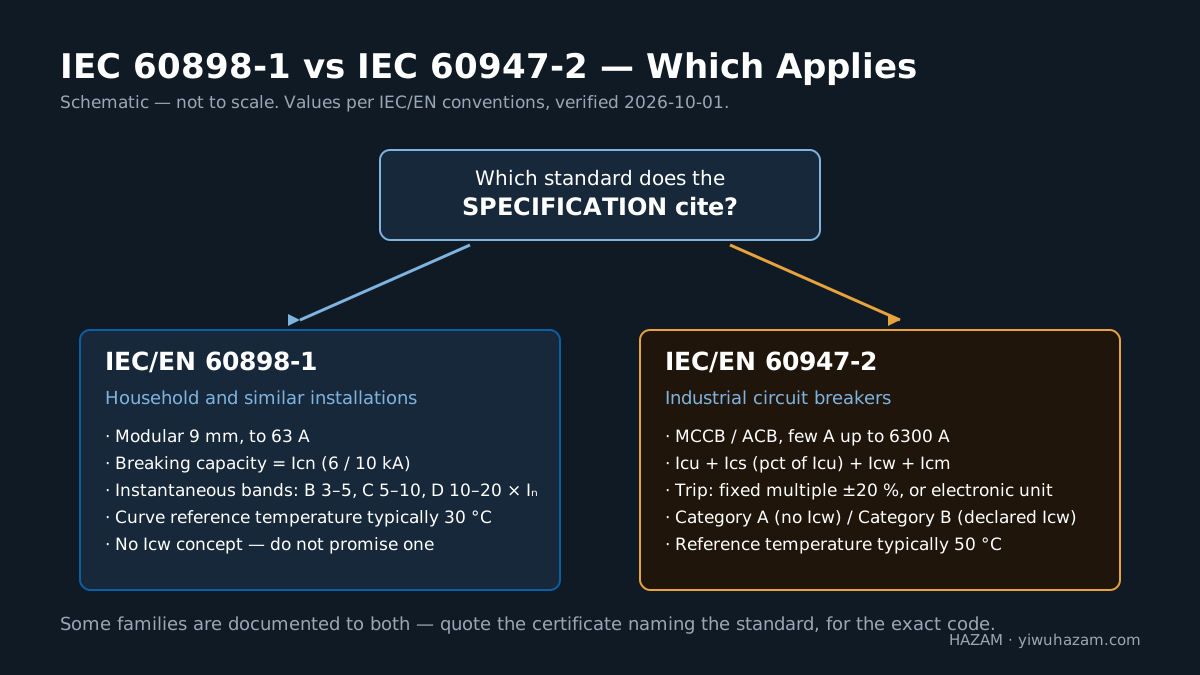
Where the two overlap — and where the confusion comes from
Many manufacturers build the same physical platform to both standards and issue two documents. In the CHINT modular range the practical picture is:
- NB1-63 is published under IEC/EN 60898-1 (Icn 6 kA) with a companion IEC/EN 60947-2 version of the same family in the manufacturer’s documentation set (where the 60947-2 variant’s Icu is stated as 10 kA). Two datasheets, two sets of conventions, one look-alike housing.
- NB1-63H stays in the 60898-1 world but at 10 kA Icn.
- NXB-63 is a 60898-1 family with 6 kA and a 10 kA H version (Ics 7.5 kA on the 2P 220–240 V case, per the manufacturer’s manual).
- Moulded cases — NM1, NXM, NM8/NM8N — are 60947-2 devices, with category A/B, Icw and adjustable or electronic trip units where offered. NXM is published by the manufacturer up to 70 kA at 400 V and 50 kA at 690 V depending on frame and version.
So when a client says “give me a 10 kA 32 A breaker”, there are at least three honest answers, and they are priced and documented differently: a 60898-1 MCB with Icn 10 kA, a 60947-2-rated modular device with Icu 10 kA, or a small MCCB frame. We quote all three with the datasheet attached and let the client’s specification pick — which is also how we avoid the situation where the goods arrive and the consultant rejects the submittal.
Practical selection rules we apply to enquiries
- Read the standard the client’s document cites, not the amperage. If it cites 60898-1, quote the modular family and state the standard on the proforma. If it cites 60947-2, quote a device whose test report is against 60947-2 — do not offer a household MCB “because it is 10 kA”.
- Check the temperature reference. A thermal curve at 30 °C and one at 50 °C are different devices on a hot busbar in a Gulf summer. Where boards are boxed tightly or mounted next to drives, this is a real derating question, not paperwork.
- Check the voltage paired with the kA. Breaking capacity is stated at a voltage. 10 kA at 230/400 V is not 10 kA at 415/440 V, and 60947-2 datasheets publish the whole table — use it.
- Ask for Icw only where it exists. Selectivity studies on modular household devices frequently ask for a parameter the device class does not carry. The correct reply is a 60947-2 frame with a rated Icw, or a fuse-and-breaker coordinated solution.
- Attachments and spares differ. 60947-2 industrial devices have a proper parts ecosystem. On 60898-1 modular devices the accessory list is short and family-specific — XF9, XF9J, S9, V9 for the NB1 platform, AX-X1/SHT-X1/UVT-X1 for the NXB platform. Quoting an accessory that physically does not fit is the fastest way to lose a repeat order.
What this means for certification paperwork
Certification follows the standard and the ordering code. A CB report against 60898-1 does not evidence 60947-2 compliance; a national certificate (EAC for the Eurasian union, SASO/SABER for Saudi Arabia, SONCAP for Nigeria, PVoC for Kenya, GOEIC registration for Egypt) is issued against a described type, and if the description names one standard and you ship the other, the paperwork does not cover the goods. This is the least visible and most expensive category of error in mixed-container orders, because the discrepancy is discovered by an inspector rather than by you. Our market pages set out the requirement per destination: grids, certificates and clearing rules.
FAQ
Q: Is an IEC 60947-2 breaker “better” than an IEC 60898-1 breaker?
A: Neither. They are different scopes: 60898-1 for household and similar installations operated by ordinary persons; 60947-2 for industrial circuit breakers with an explicitly declared breaking-capacity and withstand set. A 60947-2 device is what a specification demands when it needs Icu/Ics/Icw, category B, or maintainability.
Q: Can a modular MCB comply with both standards?
A: Yes, the same physical family can be tested and documented to either, and some manufacturers publish both. What you cannot do is assume: request the datasheet and certificate that name the standard your project requires, for the exact ordering code.
Q: My client asks for “type AC” or “category A” — which standard is that from?
A: “Category A” comes from IEC/EN 60947-2 (no rated short-time withstand current specified). “Type AC”/”Type A” on a residual-current device comes from IEC/EN 61008/61009. They are unrelated classifications and both appear in the same tender by mistake — see RCCB Type AC vs Type A.
Q: Why do 60898-1 curves say D = 10–20 In while some 60947-2 datasheets say 12 ±20 %?
A: Because the two standards express instantaneous accuracy differently: household devices declare a range of multiples, industrial devices declare a fixed multiple with a tolerance band. Quote whichever applies to the device you are supplying, from its own datasheet.
Q: Do you supply both classes?
A: We supply modular MCBs to 60898-1 (NB1-63, NB1-63H, NXB-63, and DC versions to 60947-2), MCCBs NM1/NXM/NM8N and ACBs NA1/NA8/NXA to 60947-2, plus DELIXI and TENGEN equivalents where you give us the code. [ADD: which of these you actually quote most often, and one tender where the standard mismatch would have failed the shipment]
Send us the specification document
If your enquiry carries a standard reference, attach the clause. We will quote the ordering code that answers it, with the datasheet and certificate file, plus unit price, packing data (pcs / carton / GW / CBM) and lead time — within 24 hours. Request a quotation.
Related: 6 kA vs 10 kA breaking capacity · MCB trip curve B, C or D · MCB catalogue · MCCB catalogue · cross-reference: European models to Chinese ranges
CHINT, DELIXI and TENGEN are trademarks of their respective owners. HAZAM is a first-tier authorised distributor of CHINT products; the authorisation certificate is available on request from our sales manager. Standard designations and ratings above refer to published manufacturer documentation current on 1 October 2026; the certificate for your exact ordering code governs.